“Play faster.”
It isn’t without merit, and its proponents aren’t fools. But it’s crap advice. You’ll often hear this advice given to players who find themselves in a rut, chasing an elusive promotion. Those offering speed as a solution will often point out, “Look at how fast Grand Champion players are.” You could even find data from calculated.gg that might support this point of view.
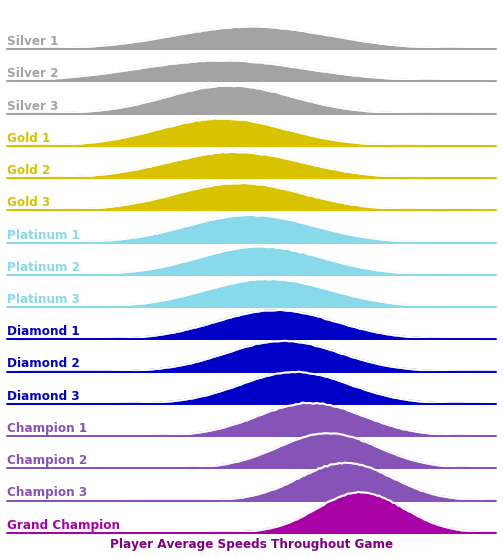
Speed and player rank have a 0.96 correlation. Amazingly there is an even stronger correlation to be found! Shooting percentage has a -0.97 correlation. So shoot the ball less accurately if you want any hope of ranking up. Except that’s ridiculous. If you take into account the growing defensive skills of players, measured in saves per game, then you can easily explain why even with more accurate shooting we’d see fewer goals.
Correlation from one metric isn’t telling us even close to the whole story here. We need to broaden our view of Rocket League rank beyond average speed.
A mean without a variance might not be so meaningful
Looking back at our distributions of player average speeds we can see that there is a non-trivial amount of overlap between the lowly Silver 1 population and the Grand Champions(1580 average MMR). The overlap occurs such that around 1/6th of the players in Silver 1 are playing at average speeds faster than about 1/4th of Grand Champions. You should expect the fastest Silver in a 3v3 lobby to be playing faster than at least one Grand Champion in a given 2v2 match a staggering 71% of the time.
Clearly, faster =/= better.
What’s really going on then?
We’re far better off asking questions with more nuance if we want to understand what this correlation between speed and rank is hinting at. That correlation lets us know that higher ranked players have a higher average, but looking at a broader scope of variables will help us understand how they have a higher average speed.
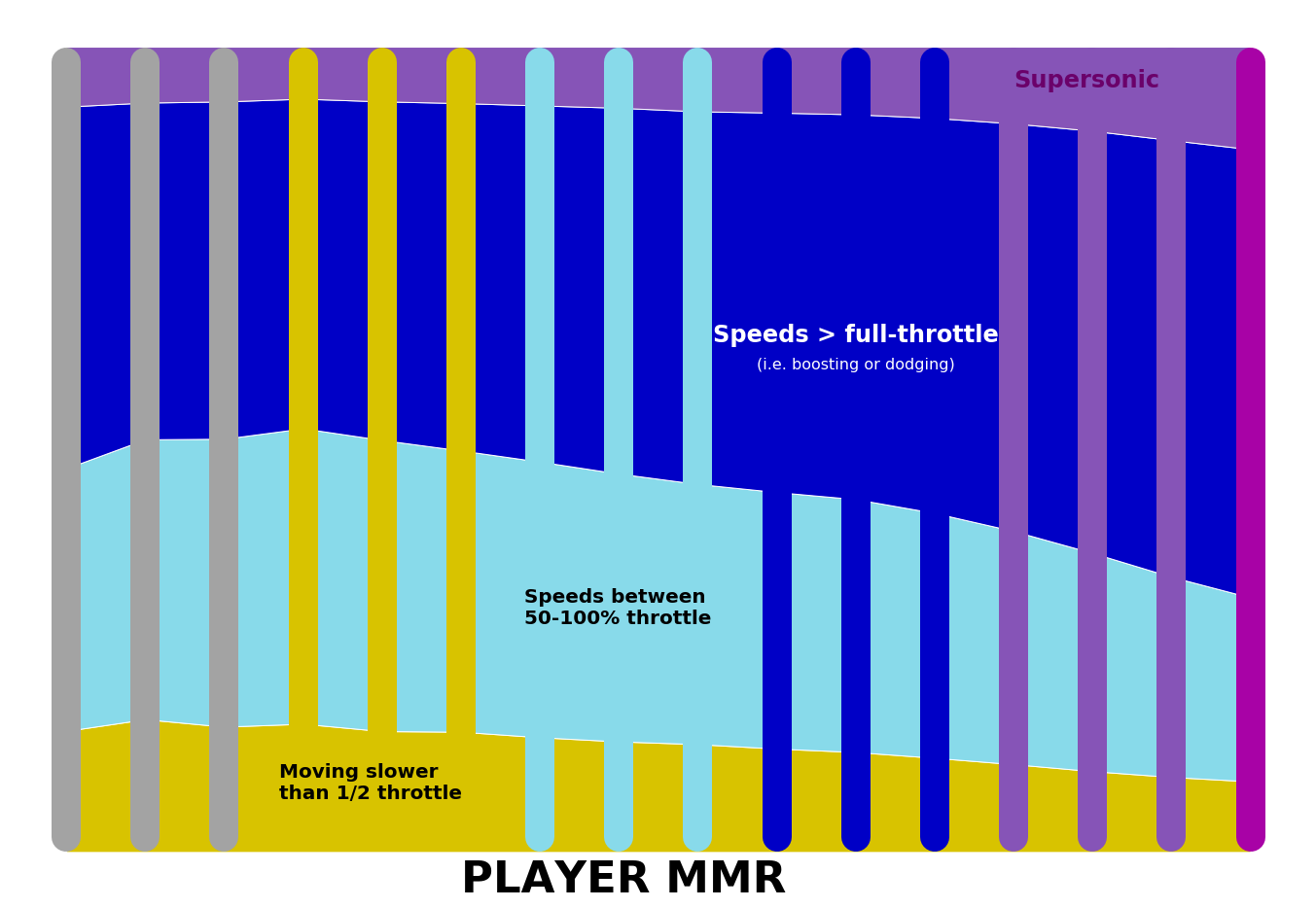
Looking at this graph we see Gold 1 is the rank where players spend the lowest proportion of their time moving at speeds throttle alone can’t reach. In contrast, Grand Champions spend more than half of their time traveling at these speeds that require a boost.
It’s unsurprising then that data shows GCs consistently have the lowest average boost level, even while they consistently collect the highest number of small boost pads as they move. Efficiently cruising and collecting in massive quantities like a baleen whale at lunch time.
As it turns out, minimizing the amount of time you’re moving slowly is even more highly correlated with rank than raw speed. A whopping 0.98. And if you still prefer giving advice about speed in small portions you’d do well to replace “drive faster” with “drive very slowly less often”.
So what is my advice if not “play faster”?
You might argue that “play faster” actually means making decisions quickly. But if you want to speed up your decisions in the short term then you’re going to degrade their quality. What should you do instead? Think more. Slowly.
Replay Analysis
Watch some of your game replays and you’ll be stunned. As you watch you’ll find moments where you’ll wonder, “What was I thinking?” Professional athletes in every sport watch game replays to design slowly considered plans that can later become rapid recognition and action. It’s surprising how often glaring patterns of mistakes will jump out at you and better alternatives come to mind when you have the luxury of time and perspective. With replay analysis you can coach yourself into building new habits and to new heights on the competitive ladder.
Drive faster and think less? Let’s drive smarter and think differently